

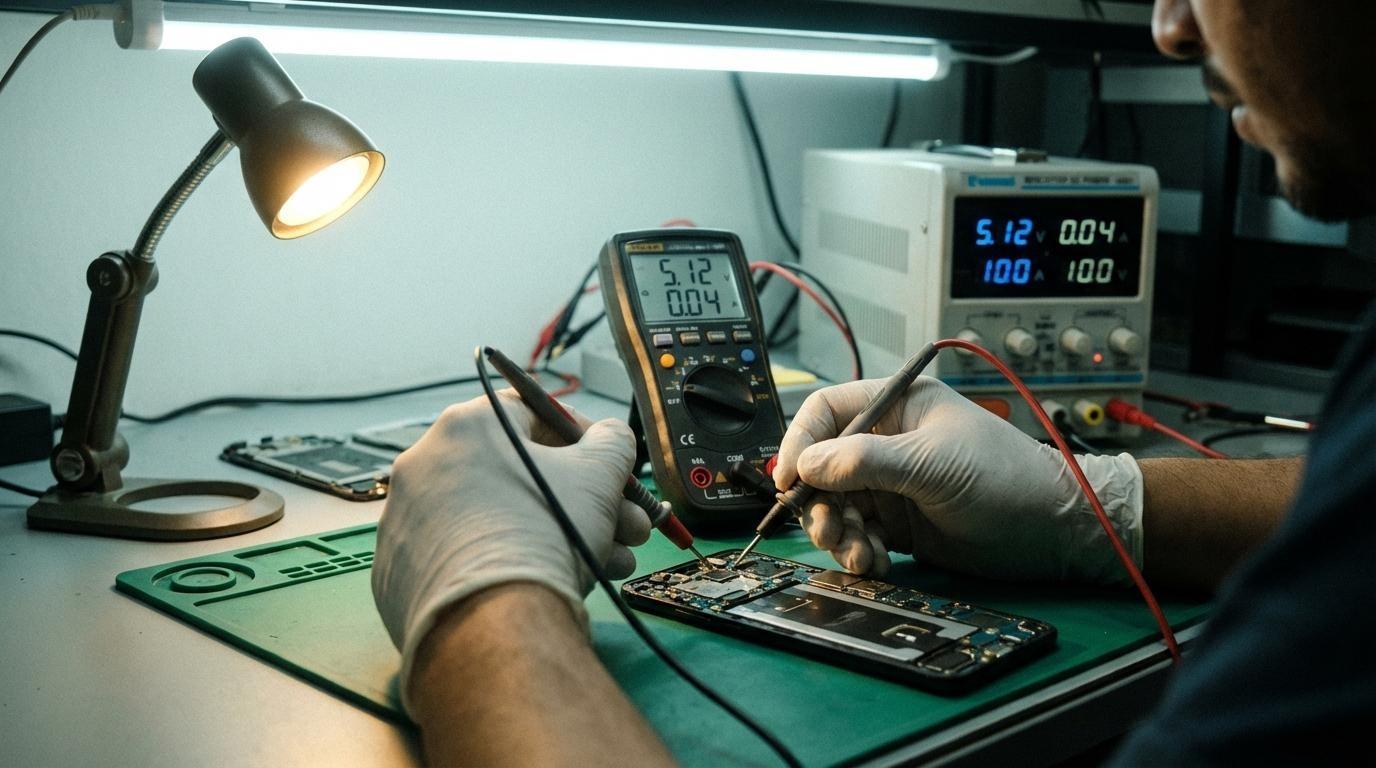
How to Choose a DC Power Supply for Mobile Phone Repair in Kenya
A DC power supply for mobile phone repair provides controlled voltage and current to a phone or electronic circuit during testing and troubleshooting. It helps technicians investigate power-related faults, observe current consumption and perform controlled motherboard diagnostics without relying entirely on a phone battery.
When choosing one, pay attention to its voltage range, current capacity, adjustment accuracy, display, protection features and build quality. A 30V 5A unit offers more capacity and flexibility than a basic low-current supply, but the right choice depends on the repairs you handle.
This guide explains what to look for before buying a DC power supply in Kenya.
What is a DC power supply used for in mobile phone repair?
A DC bench power supply converts mains electricity into a regulated direct-current output. The technician can adjust the output voltage and current limit to suit the testing task.
In a phone repair workshop, it can help with:
- Power-on diagnostics: Supplying controlled power to a device or compatible test connection when investigating power-related faults.
- Current-consumption observation: Monitoring how much current a connected circuit draws under defined test conditions.
- Motherboard troubleshooting: Supporting investigations into short circuits, abnormal current draw and power-related faults.
- Battery-related testing: Providing a controlled source for suitable battery-terminal or test-point procedures, where the device and procedure allow it.
- Electronics testing: Powering compatible electronic circuits and repair accessories that require a regulated DC source.
A power supply is a diagnostic aid, not a device that automatically identifies or repairs a fault. Correct connection, polarity, voltage selection and current limiting remain essential.
1. Check the voltage range
Voltage determines the electrical potential supplied to the connected circuit. Your power supply should offer a range suitable for the equipment and diagnostic procedures you perform.
Many mobile phone repair technicians consider adjustable supplies with a maximum output of 15V or 30V. A higher maximum voltage does not mean you should apply that voltage to a phone.
Always use the voltage specified by the device, battery, test point or repair procedure. Applying an unsuitable voltage can damage components and the motherboard.
Practical advice: Choose a supply with a useful adjustment range and clear voltage display. Precision and controlled adjustment matter more than simply buying the highest voltage rating.
2. Understand the current rating: 2A, 3A or 5A
The current rating indicates the maximum current the supply can provide under its specified operating conditions.
For example:
- 2A: May suit basic electronics testing and lower-current applications.
- 3A: Provides additional current capacity for a wider range of bench-testing tasks.
- 5A: Offers greater capacity for compatible applications that require more current.
A 5A power supply does not force 5A into every connected phone. The load draws current according to its electrical characteristics, while the supply’s current limit helps restrict the maximum available current.
For phone motherboard diagnostics, the ability to set and observe current is particularly useful. However, the correct current limit depends on the specific test procedure.
3. Consider a 30V 5A power supply
A 30V 5A bench supply provides a maximum rated output of 30 volts and 5 amps, subject to the unit’s operating limits.
It can be a flexible choice for a workshop that handles phone repair alongside other compatible electronics work.
Before buying, check:
- Whether voltage and current can be adjusted independently.
- Whether the display shows both voltage and current clearly.
- Whether the unit supports constant-voltage and constant-current operation.
- Whether it includes overcurrent and overvoltage protection.
- Whether the output remains stable under the loads you intend to test.
- Whether the seller can confirm the exact model specifications and warranty.
Do not choose a 30V 5A model simply because its ratings are higher. Choose it because its capacity and controls suit your actual work.
4. Look for constant-voltage and constant-current modes
Two important operating modes are constant voltage (CV) and constant current (CC).
| Mode | What it does | Why it matters |
|---|---|---|
| Constant voltage (CV) | Maintains the selected voltage while the load remains within the current limit | Useful for supplying a controlled voltage |
| Constant current (CC) | Limits output current to the selected value when the load demands more | Helps control the maximum current available |
A good bench supply should make its operating mode easy to identify. Clear CV and CC indicators help technicians understand how the supply is responding during a test.
5. Check the display and adjustment controls
A digital display makes it easier to monitor output voltage and current while working.
Look for:
- Clear voltage and current readings.
- Fine adjustment controls for accurate settings.
- Separate voltage and current controls.
- Readable displays under normal workshop lighting.
- Preset or memory functions, if useful for your workflow.
- Clearly labelled output terminals.
Some models include programmable memory, allowing commonly used settings to be recalled. This can save time, but it should not replace checking the settings before connecting a device.
6. Prioritise protection and build quality
A DC power supply is connected directly to electronic circuits, so safety and reliability matter.
Check whether the model provides:
- Overcurrent protection.
- Overvoltage protection.
- Short-circuit protection.
- Overtemperature protection.
- Stable output regulation.
- Properly insulated terminals and good-quality leads.
- Adequate cooling and ventilation.
Confirm which protections are actually included in the manufacturer’s specifications. Do not assume every unit has all of them.
7. How to choose the right DC power supply for your workshop
Your choice should reflect the type of work you handle and the equipment you already own.
| Workshop requirement | What to prioritise |
|---|---|
| Basic electronics testing | Stable output and straightforward controls |
| Phone power diagnostics | Adjustable voltage, current limiting and clear readings |
| Motherboard troubleshooting | Fine adjustment, useful current range and reliable protection |
| Mixed electronics work | A wider voltage and current range, where appropriate |
| Busy repair workshop | Durable construction, cooling and dependable performance |
For a technician who regularly handles motherboard diagnostics, a regulated bench supply with adjustable voltage and current is generally more useful than a basic fixed-output adapter.
Common mistakes to avoid when buying a DC power supply
Buying based only on the maximum amperage: A high current rating does not automatically mean better accuracy, stability or protection.
Ignoring adjustment precision: Coarse controls can make it difficult to select the settings required for a particular test.
Overlooking protection features: Confirm the unit’s actual safety specifications before purchasing.
Choosing an unsuitable voltage range: The maximum output should not determine the voltage you apply to a phone.
Using poor-quality leads: Damaged or unsuitable cables can introduce resistance, unstable connections and unreliable readings.
Connecting a device without checking polarity: Incorrect connections can damage components. Verify positive and negative terminals before applying power.
Frequently asked questions
What DC power supply is best for mobile phone repair?
A regulated bench power supply with adjustable voltage and current, clear digital readings and appropriate protection features is a practical choice. The ideal voltage and current capacity depend on the diagnostic work you perform.
Is a 30V 5A power supply suitable for phone repair?
It can be suitable for a phone repair workshop that needs a versatile bench supply. However, the technician must set the correct voltage and current limit for each test. The maximum 30V output should never be applied to a phone simply because the supply can provide it.
What does 5A mean on a DC power supply?
It indicates the supply’s maximum rated current capacity under specified conditions. It does not mean the supply continuously pushes 5 amps into every connected device.
Can a DC power supply help identify a short circuit on a phone motherboard?
Yes. When used with an appropriate diagnostic procedure, it can help a technician observe abnormal current consumption and investigate possible short circuits. It does not identify the faulty component by itself.
What is the difference between a DC power supply and a phone charger?
A phone charger is designed to charge compatible batteries or devices using its specified charging protocol and output. A bench DC power supply provides adjustable, controlled output for electronics testing and diagnostics. They are not interchangeable in every situation.
Should a beginner buy a 30V 5A DC power supply?
A beginner can choose one if the budget allows and the unit has suitable adjustment and protection features. However, learning correct voltage selection, polarity and current limiting is more important than buying a higher-rated model.
Buy mobile phone repair equipment in Nairobi
Choosing the right DC power supply is an investment in accurate diagnostics and a more capable repair bench. Compare the specifications carefully and select equipment that matches the work you perform.
Mutesh Ventures Ltd supplies mobile phone repair tools and equipment to technicians and repair businesses in Kenya, including power supplies, soldering equipment, microscopes and other workshop essentials.
Visit Mutesh Ventures to explore the catalogue or contact the team for product availability and guidance.
Mutesh Ventures Ltd
Accra Towers, 7th Floor, Shop D3, Kenneth Matiba Road, Nairobi CBD, Kenya
Phone: 0724 946 622
Email: contact@muteshventures.com

Add a review
Your email address will not be published. Required fields are marked *