

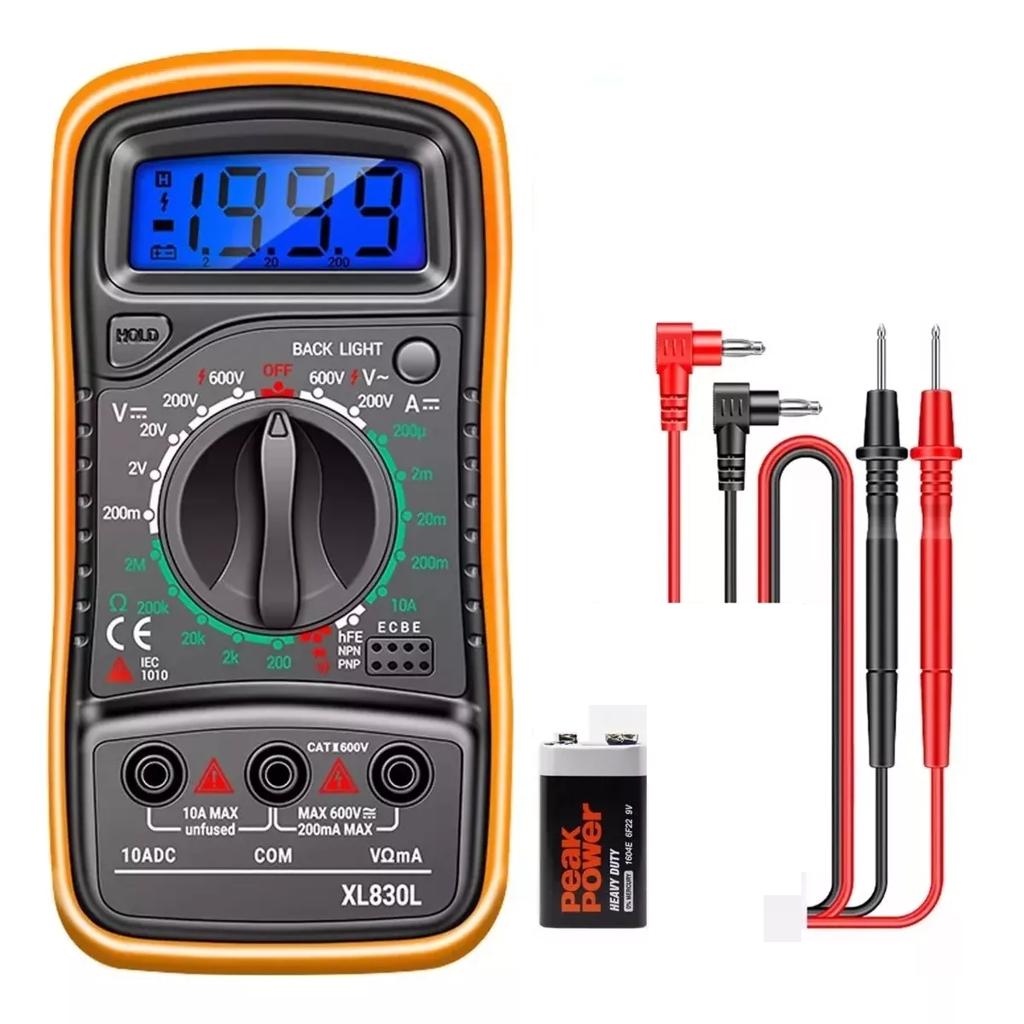
Best Multimeters for Mobile Phone Repair Technicians: What to Look For
A digital multimeter is one of the most important tools on a mobile phone repair technician’s workbench. It helps you measure voltage, resistance and current, check continuity and investigate electrical faults on phone charging circuits and motherboards.
But which multimeter should you buy?
For most phone repair technicians, a reliable digital multimeter with accurate voltage and resistance readings, continuity testing, diode testing and good-quality test probes is a practical starting point. More advanced technicians may benefit from additional features such as capacitance, frequency and temperature measurement.
This guide explains what to look for when choosing a multimeter for mobile phone repair in Kenya.
What is a multimeter used for in mobile phone repair?
A multimeter is an electronic measuring instrument used to check different electrical properties in a circuit.
In phone repair, technicians commonly use it to:
- Measure voltage at battery terminals and specified motherboard test points.
- Check continuity across tracks, connectors and circuit paths.
- Measure resistance when investigating suspected faults.
- Perform diode-mode checks on suitable motherboard connections.
- Investigate charging and power-related problems.
- Check cables, connectors and other electrical components.
A multimeter does not automatically identify a faulty component. It provides measurements that help a technician investigate the circuit and make informed repair decisions.
1. Choose a digital multimeter with the right measurement functions
Not every multimeter has the same features. Before buying, check which measurement functions are available and whether they suit the work you perform.
| Function | What it measures or checks | Use in phone repair |
|---|---|---|
| DC voltage | Direct-current electrical potential | Checking battery voltage and specified circuit test points |
| AC voltage | Alternating-current electrical potential | General electrical testing where required |
| Resistance | Opposition to electrical current | Investigating resistive paths and components |
| Continuity | Whether an electrical path is connected | Checking tracks, wires and connectors |
| Diode test | Forward voltage behaviour of a diode or semiconductor junction | Comparing suitable motherboard test points |
| Capacitance | Capacitance of a component | Testing suitable capacitors |
| Current | Electrical current through the meter | Measuring current when connected correctly in series |
For most mobile phone motherboard work, DC voltage, resistance, continuity and diode testing are particularly useful.
Do not assume a multimeter supports every function simply because it has a digital display. Check the manufacturer’s specifications before purchasing.
2. Why diode mode matters in motherboard repair
Diode mode is a useful function for technicians working on smartphone motherboards.
It measures the voltage drop across a semiconductor junction under the meter’s test conditions. Technicians can use diode readings to compare suitable test points and investigate possible abnormalities.
For example, when diagnosing a suspected motherboard fault, a technician may compare readings from corresponding points or known-good board references.
However, diode readings are not universal fault codes. Results depend on the phone model, circuit design, test-point location and measurement conditions.
A good multimeter should provide stable readings and make it easy to select diode mode.
3. Check the multimeter’s accuracy and resolution
Accuracy and resolution are not the same thing.
- Accuracy describes how close a measurement is to the actual value.
- Resolution describes the smallest change the meter can display.
A meter may display several decimal places without necessarily being highly accurate.
For phone repair, reliable readings matter more than a large number of digits on the screen.
When comparing multimeters, look for the manufacturer’s accuracy specifications for the measurement ranges you expect to use. A reputable meter with clear specifications is generally a better choice than an unknown model making unsupported accuracy claims.
4. Look for a clear digital display
A readable display makes everyday testing easier, especially when working with small motherboard components.
Consider:
- Large, clear digits.
- A backlight for poorly lit work areas.
- An easy-to-read measurement range.
- Clear function symbols.
- A display that updates reliably.
- A suitable screen angle for bench work.
Some multimeters include automatic range selection, commonly called auto-ranging. This allows the meter to select an appropriate measurement range automatically.
Manual-ranging meters can also be useful, particularly for technicians who understand the ranges and prefer direct control.
5. Check the test probes and input protection
The test leads are an important part of the multimeter. Poor-quality probes can make measurements unreliable and create unnecessary frustration.
Look for:
- Properly insulated test leads.
- Secure probe connections.
- Sharp, suitable probe tips for precision work.
- Good-quality cable insulation.
- Clearly marked input sockets.
- Appropriate fuses and input protection.
For motherboard testing, fine probe tips can make it easier to contact small test points without accidentally touching neighbouring components.
Always inspect the probes for damaged insulation or exposed conductors before use.
6. Auto-ranging vs manual-ranging multimeters
Both types can be useful in a mobile phone repair workshop.
| Feature | Auto-ranging | Manual-ranging |
|---|---|---|
| Range selection | Meter selects the range | Technician selects the range |
| Ease of use | Generally easier for beginners | Requires familiarity with ranges |
| Speed | Convenient for routine checks | Can be faster once the technician is familiar with the meter |
| Control | Less direct control over range selection | More direct control |
| Best suited to | General-purpose testing and convenience | Technicians who prefer manual control |
If you are buying your first multimeter, an auto-ranging model can make routine measurements more convenient. However, a well-made manual-ranging meter can also perform useful diagnostic work.
7. Do you need an expensive multimeter?
Not necessarily.
A technician starting out may not need a premium professional meter with every available measurement function.
The right choice depends on:
- How frequently you perform motherboard-level repairs.
- Whether you need diode-mode measurements.
- The accuracy required for your work.
- The quality of the probes and input protection.
- Your budget.
- Whether the meter has clear manufacturer specifications.
A basic meter with reliable voltage, resistance and continuity functions may be enough for simple electrical checks. More advanced repair work can justify investing in a better instrument.
Avoid choosing solely by price. An unreliable meter can lead to misleading readings and wasted diagnostic time.
8. Multimeter vs DC power supply: What is the difference?
A multimeter and a DC bench power supply serve different purposes. They complement each other rather than replace one another.
| Equipment | Main purpose | Example in phone repair |
|---|---|---|
| Digital multimeter | Measures electrical properties | Checking voltage, resistance and continuity |
| DC bench power supply | Provides controlled DC output | Supplying power through a suitable diagnostic connection and observing current consumption |
A multimeter helps you investigate what is happening at specific circuit points. A DC power supply provides controlled power for suitable testing procedures.
For more information, read our guides:
- How to choose a DC power supply for mobile phone repair
- 30V 5A vs 15V 2A DC power supply: Which one do you need?
- How to use a DC power supply to diagnose mobile phone charging problems
9. Common multimeter mistakes to avoid
Using the wrong measurement mode: Confirm whether you are measuring voltage, resistance, continuity or current before taking a reading.
Measuring resistance on an energised circuit: Switch off and isolate the circuit as required before resistance or continuity testing.
Using the wrong input socket: Current measurements often require a different meter input. Check the meter markings and manual before connecting the probes.
Measuring current incorrectly: Current measurements generally require the meter to be connected in series with the circuit. Incorrect connections can damage the meter or circuit.
Ignoring probe condition: Damaged test leads can produce unreliable readings and create safety risks.
Assuming every diode reading is a fault code: Interpret readings in the context of the board design, test-point location and known-good references.
Buying based only on the number of functions: A long feature list does not guarantee accuracy, durability or good input protection.
Frequently asked questions
Which multimeter is best for mobile phone repair?
Choose a reliable digital multimeter with DC voltage, resistance, continuity and diode-test functions. Good test probes, clear accuracy specifications and appropriate input protection are also important.
Is diode mode important for phone motherboard repair?
Yes. Diode mode is useful for investigating semiconductor junctions and comparing suitable motherboard test points. However, readings must be interpreted using the correct board references and diagnostic procedure.
Can a multimeter detect a short circuit on a phone motherboard?
A multimeter can help investigate suspected short circuits using suitable resistance, continuity and diode-mode tests. It may help narrow down the affected circuit, but further diagnosis is often required to identify the exact faulty component.
Should I buy an auto-ranging or manual-ranging multimeter?
Auto-ranging is convenient for beginners and routine testing. Manual-ranging meters offer direct control and can be effective for technicians who are familiar with measurement ranges.
Can I use a cheap multimeter for phone repair?
A budget multimeter can handle basic measurements if its specifications and construction are suitable. For regular motherboard diagnostics, prioritise dependable readings, good probes and appropriate input protection over the lowest purchase price.
Do I need both a multimeter and a DC power supply?
For many advanced phone repair tasks, both are useful. A multimeter measures electrical properties at specific points, while a DC power supply provides controlled power for suitable diagnostic procedures.
Find mobile phone repair tools in Nairobi
A reliable multimeter is an essential part of a technician’s diagnostic toolkit. Whether you are starting a repair workshop or improving an existing setup, choose equipment that provides dependable readings and suits the work you perform.
Mutesh Ventures Ltd supplies mobile phone repair tools and equipment in Kenya, including diagnostic equipment, soldering stations, power supplies, microscopes and workshop accessories.
The Mutesh catalogue has listed the XL830L Multimeter. Check the Mutesh Ventures website for current availability and product details before ordering.
For enquiries, contact the team or visit the Nairobi shop.
Mutesh Ventures Ltd
Accra Towers, 7th Floor, Shop D3, Kenneth Matiba Road, Nairobi CBD, Kenya
Phone: 0724 946 622
Email: contact@muteshventures.com
Add a review
Your email address will not be published. Required fields are marked *